

A complete environmental accounting of a 2020 Ram 3500 6.7L Cummins, stock versus deleted, over a 300,000 km service life
Most conversations about diesel emissions equipment fall into one of two camps. Regulators and manufacturers state that the system works and is necessary. A substantial portion of diesel truck owners argue that it is unreliable, expensive, and does not deliver the environmental benefit it claims. Both positions contain truth.
This article attempts to account for the environmental impact of the truck over the course of its life. The goal is not advocacy for or against any modification, but a transparent, data driven comparison of the total environmental cost of a modern diesel emissions system, measured against the same vehicle without one. The analysis is applied to a specific and widely owned vehicle: the 2020 Ram 3500 with the 6.7L Cummins engine, used for mixed daily driving and regular towing over a 300,000 km service life in a cold climate.
A note on what this analysis can and cannot prove. As the sections below make clear, the climate comparison between a stock and a deleted truck is genuinely uncertain, and the result depends heavily on two contested variables: the real world fuel economy penalty of the emissions system, and how the warming effect of black carbon is counted. This article presents the full range rather than a single tidy answer, because the honest result is a range.

1. What the Emissions System Does
A modern Ram 2500 or 3500 with the 6.7L Cummins operates three major emissions control subsystems in concert.
Exhaust Gas Recirculation (EGR) recirculates a portion of exhaust gas back into the intake to lower peak combustion temperatures, which reduces the formation of nitrogen oxides (NOx). NOx is a precursor to ground level ozone and is associated with respiratory health effects.
Diesel Particulate Filter (DPF) captures soot and particulate matter from the exhaust stream. It periodically burns off accumulated soot through active regeneration cycles that inject fuel into the exhaust to raise filter temperatures to roughly 1,100 degrees Fahrenheit.
Selective Catalytic Reduction (SCR) with Diesel Exhaust Fluid (DEF) injects a urea solution into the exhaust, where it reacts with NOx across the SCR catalyst to produce nitrogen and water. This is the primary NOx reduction mechanism and can reduce tailpipe NOx by up to 90 percent when the system is functioning correctly (Ou et al., 2019).
On paper this is a highly effective system. In practice, the complete environmental picture is considerably more complicated.
2. The Fuel Economy Penalty, and Why It Is Contested
The emissions equipment produces fuel economy losses through three mechanisms: DPF backpressure that the engine works against, EGR dilution of the intake charge that reduces combustion efficiency, and active regeneration that burns fuel purely to clean the filter rather than to move the truck.
The size of that penalty, however, is the single most contested number in this entire analysis, and it deserves direct treatment because almost the entire climate comparison depends on it.
Owner reported data following full emissions removal commonly shows improvements of 2 to 5 miles per gallon (CumminsForum, 2013 to 2024). This data is weak evidence, for several reasons. Owners who delete a truck frequently install performance tuning at the same time, change tire sizes or gear ratios, and alter their driving style. Reporting bias is strong, because an owner who spent thousands of dollars on a delete is highly motivated to notice and report fuel savings. No controlled, peer reviewed study has isolated the fuel economy difference on a light duty 2500 or 3500 specifically.
Working in the other direction, modern SCR systems can actually permit more fuel efficient engine tuning than older EGR heavy strategies, because NOx is treated downstream in the catalyst rather than suppressed in cylinder through aggressive exhaust gas recirculation. For this reason, controlled testing on modern SCR equipped diesels has in some cases found fuel economy penalties as low as 3 to 5 percent, well below the figures owners report.
Because the true number is unsettled, this analysis does not rely on a single value. It uses a base case of a 2.5 mile per gallon improvement, which on a 15 mile per gallon (US) stock baseline represents about a 14 percent reduction in fuel consumed. It then tests that assumption directly in a sensitivity analysis in Section 9. A reader should treat the base case as the upper end of what is plausible, not as a settled figure.
For the base case: stock at 15 miles per gallon (15.7 L/100km) and deleted at 17.5 miles per gallon (13.4 L/100km).
3. The DEF Supply Chain: Hidden Carbon
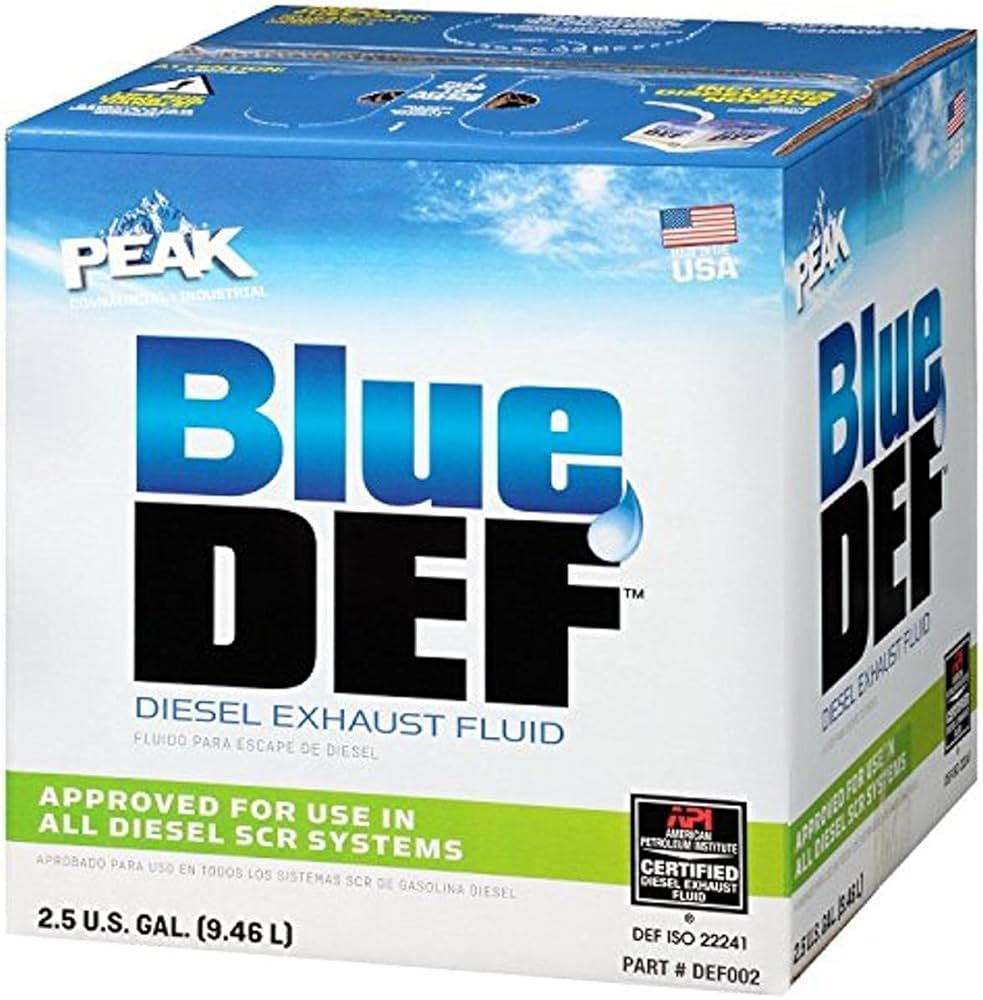
DEF is a solution of 32.5 percent urea in deionized water, as defined by the ISO 22241 standard. Urea is produced through the Haber-Bosch process, which synthesizes ammonia from nitrogen and hydrogen at roughly 150 to 250 bar and 400 to 500 degrees Celsius. Conventional ammonia production using natural gas as the hydrogen feedstock generates approximately 1.6 tonnes of CO2 per tonne of ammonia produced (International Energy Agency, 2021). The synthesis of urea requires roughly 0.57 tonnes of ammonia per tonne of urea, based on the stoichiometry of the urea formation reaction.
Over the service life modelled here, the stock truck burns approximately 47,040 litres of diesel. At a DEF consumption rate of 3 percent of fuel volume (Ou et al., 2019), this corresponds to roughly 1,411 litres of DEF, or about 1,538 kg. At 32.5 percent urea, that represents approximately 500 kg of urea, which requires roughly 283 kg of ammonia to produce. At 1.6 kg of CO2 per kg of ammonia, the carbon cost of producing the DEF consumed by a single truck over its lifetime is approximately 453 kg of CO2, before accounting for packaging and transportation.
4. The Plastic Waste Problem
DEF is sold primarily in 2.5 gallon (9.46 litre) high density polyethylene (HDPE) jugs. A truck consuming 1,411 litres of DEF over its lifetime uses approximately 149 of these jugs. At roughly 275 grams of HDPE per jug, this generates about 41 kg of HDPE plastic from DEF packaging alone.
Manufacturing virgin HDPE generates approximately 2.0 kg of CO2 per kg of plastic (Journal of Renewable Materials, 2021). The production of 41 kg of HDPE jugs therefore carries a manufacturing footprint of approximately 82 kg of CO2.
North American HDPE recycling rates are approximately 30 percent (Association of Plastic Recyclers, 2020). The recycled fraction, roughly 12 kg, passes through mechanical recycling at an intensity of about 0.3 tonnes of CO2 per tonne processed (Thunder Said Energy, 2024), adding a further 3.7 kg of CO2. The remaining 29 kg of HDPE is typically landfilled, where it remains chemically stable for over a century with negligible CO2 release.
Each jug ships in a cardboard carton weighing approximately 120 grams. Across 149 cartons, and accounting for an approximately 80 percent cardboard recycling rate, packaging adds roughly 10 kg of CO2.
DEF transportation from production facility to retail point adds approximately 62 kg of CO2, based on 1.538 tonnes of DEF moved roughly 500 km through a multi leg supply chain at a standard diesel freight intensity of 0.08 kg of CO2 per tonne kilometre.
The packaging and logistics footprint, excluding the urea production cost already accounted for above, totals approximately 154 kg of CO2 over the vehicle lifetime.
5. Failure Rates and the Embodied Cost of Replacement Parts
The components that reduce tailpipe emissions are themselves sources of pollution through their manufacturing, replacement, and disposal. It is important, however, to be honest about how often these parts actually fail, because failure rates vary widely and using worst case assumptions would bias the analysis.
Many 2019 and newer Cummins trucks reach 300,000 km on their original aftertreatment hardware. Others, particularly those used for short trips in cold climates where passive regeneration is less effective, experience repeated failures. The figures below assume a moderate, above average failure scenario, and they should be read as the upper portion of a realistic range rather than a typical outcome. A fleet average would be lower.
DPF failures are among the more expensive issues on this platform. Out of warranty original equipment DPF replacement costs 2,500 to 3,500 US dollars in parts alone (SPELAB, 2025). Using catalyst loading data from Ou et al. (2019) and scaling by engine displacement, each DPF contains approximately 2.95 grams of platinum group metals. Mining and refining platinum generates approximately 40 kg of CO2 per ounce, or roughly 1.29 kg per gram (Physical Gold, 2025), so the platinum group metal content embodies about 3.8 kg of CO2, with the ceramic substrate and steel canister adding an estimated 15 kg per unit. Assuming one replacement over the vehicle lifetime, total DPF related manufacturing emissions are approximately 38 kg of CO2. A 2024 lifecycle assessment found that remanufactured DPFs reduce global warming potential by 47 percent relative to new units (Tomita et al., 2024).
EGR cooler and valve failures are well documented. Cummins specifies a 67,500 mile cleaning interval that most owners never perform (DrivingLine, 2016). An EGR cooler weighs roughly 2.5 kg of stainless steel and aluminum. Applying standard lifecycle values, one to two replacements add approximately 16 kg of CO2.
NOx sensors fail with some regularity, at 450 to 900 US dollars each (InstantCarFix, n.d.). In one documented case, an owner paid 8,100 US dollars for NOx sensor and SCR system replacement on a 2013 Ram 2500 at 176,000 miles (CumminsForum, 2024). Two to four replacements add approximately 6 kg of CO2.
SCR catalyst deterioration typically begins between 120,000 and 150,000 miles (Diesel Patriots, n.d.). One replacement adds approximately 12 kg of CO2.
DEF heater, pump, and injector failures are more common on 2013 to 2018 trucks in cold climates, where DEF freezing at minus 11 degrees Celsius (12 degrees Fahrenheit) accelerates heater degradation. Two replacement cycles add approximately 5 kg of CO2.
Total parts manufacturing and replacement emissions, under this moderate to above average failure scenario, are approximately 77 kg of CO2. Even doubling this figure would not materially change the overall comparison, because it is small relative to fuel.
6. The Direct CO2 Comparison
2020 Ram 3500 6.7L Cummins, 300,000 km service life, base case fuel economy assumption
| Emission Source | Stock Truck | Deleted Truck | Basis |
|---|---|---|---|
| Fuel combustion | 126,067 kg | 108,058 kg | 2.68 kg CO2 per litre diesel |
| DEF production (Haber-Bosch) | 453 kg | 0 | Ou et al. 2019; IEA 2021 |
| DEF packaging (HDPE and cardboard) | 92 kg | 0 | LCA data |
| DEF transportation | 62 kg | 0 | Freight emissions estimate |
| Replacement parts (DPF, EGR, sensors, SCR, DEF) | 77 kg | 0 | Materials and LCA estimates |
| Direct CO2 total | approximately 126,751 kg | approximately 108,058 kg | |
| Difference | Stock produces approximately 18,693 kg more direct CO2 | ||
On a direct CO2 basis, and only on a direct CO2 basis, the stock truck produces roughly 18,700 kg more over its life. The non fuel sources total about 684 kg, or 4 percent of the gap. Fuel efficiency accounts for the other 96 percent.
This figure is incomplete because CO2 is not the only thing a diesel engine emits that affects the health of our environment.
7. NOx and Particulate Matter: Where the Emissions System Clearly Wins
The emissions system exists primarily to control NOx and particulate matter, and on those measures it succeeds substantially.
The figures below use the EPA 2010 certified standard of 0.2 g/bhp-hr NOx for the stock truck (U.S. EPA, 2016) and a conservative estimate of 1.5 g/bhp-hr for a well tuned deleted diesel. Converting brake specific standards to a per kilometre basis requires assumptions about average load and speed, so the absolute lifetime figures should be read as estimates. The ratio between the two vehicles is robust, because it reflects the ratio of the underlying standards.
| Pollutant | Stock Truck | Deleted Truck | Ratio |
|---|---|---|---|
| Lifetime NOx | approximately 90 kg | approximately 675 kg | Deleted produces 7.5 times more |
| Lifetime PM2.5 | approximately 4.5 kg | approximately 45 kg | Deleted produces 10 times more |
A deleted truck is not a single engineering configuration. Emissions from tampered vehicles vary dramatically depending on calibration, operating conditions, injector health, turbocharger performance, fuel quality, and whether the vehicle is tuned primarily for efficiency, power, or visible smoke output. The deleted emissions figures used in this analysis should therefore be interpreted as representative estimates rather than universal values. Actual NOx and particulate emissions from deleted vehicles can vary substantially above or below the values presented here.
First, real world testing of tampered diesel vehicles has frequently found NOx exceeding certification limits by 10 to 20 times or more depending on operating conditions, so the 7.5 times figure used here is conservative. Second, the EPA Cummins consent decree of 2023 established that 2013 to 2019 Ram 2500 and 3500 trucks used defeat device software that elevated real world NOx above the certified standard even in stock form (U.S. EPA, 2023), which narrows the stock to deleted gap for those specific model years but does not change the direction of the result.

8. Black Carbon: The Climate Impact the CO2 Table Misses
Here is the factor that the direct CO2 comparison in Section 6 leaves out entirely, and it is large enough to change the conclusion.
Diesel particulate matter is not climate neutral. Roughly 75 percent of diesel PM by mass is black carbon, with most of the remainder being organic carbon (Clean Air Task Force, 2019). Black carbon is a potent short lived climate forcer. It absorbs sunlight directly in the atmosphere and, when deposited on snow and ice, accelerates melting. Although it remains airborne for only days to weeks, its warming effect per unit mass is far greater than CO2. A widely cited peer reviewed estimate places the 100 year global warming potential of black carbon at approximately 680, and the 20 year value at approximately 2,200 (Bond and Sun, 2005). Other assessments range from roughly 450 to 900 on a 100 year basis.
The DPF removes about 90 percent of this particulate. The deleted truck does not. From Section 7, the deleted truck produces approximately 40.5 kg more PM2.5 over its lifetime. At a 75 percent black carbon fraction, that is roughly 30 kg of additional black carbon.
Converting that to CO2 equivalent:
| Metric | Black carbon GWP | Deleted truck extra black carbon | CO2 equivalent |
|---|---|---|---|
| 100 year basis (central) | 680 | 30 kg | approximately 20,400 kg CO2e |
| 100 year basis (low end) | 450 | 30 kg | approximately 13,500 kg CO2e |
| 100 year basis (high end) | 900 | 30 kg | approximately 27,000 kg CO2e |
| 20 year basis | 2,200 | 30 kg | approximately 66,000 kg CO2e |
This is the critical result. On a 100 year basis using the central estimate, the deleted truck’s extra black carbon represents about 20,400 kg of CO2 equivalent warming, which exceeds the roughly 18,700 kg of direct CO2 the stock truck produces in excess. On a 20 year basis, the black carbon penalty of the deleted truck dwarfs everything else in this analysis.
In other words, once black carbon is included, the deleted truck’s apparent climate advantage from better fuel economy is largely or entirely cancelled out, and under most assumptions reversed. The organic carbon fraction of diesel PM has a small offsetting cooling effect that is conservatively ignored here, and black carbon GWP is itself an area of active scientific uncertainty, so this should be read as a range rather than a precise figure. But the direction is clear and it runs opposite to the direct CO2 table.
9. Sensitivity Analysis: How the Conclusion Depends on Assumptions
Because the climate comparison rests on two uncertain numbers, the fuel economy penalty and the black carbon GWP, the only honest way to present it is to show how the result moves across the plausible range of each.
Deleted truck direct CO2 advantage, by assumed fuel economy improvement (300,000 km, 15 mpg stock baseline):
| Fuel economy gain after delete | Deleted truck direct CO2 advantage |
|---|---|
| +0.5 mpg (to 15.5) | approximately 4,000 kg |
| +1.0 mpg (to 16.0) | approximately 7,900 kg |
| +2.0 mpg (to 17.0) | approximately 14,800 kg |
| +2.5 mpg (to 17.5, base case) | approximately 18,000 kg |
| +3.0 mpg (to 18.0) | approximately 21,000 kg |
Net climate effect (positive means the deleted truck is worse for the climate), using the central 100 year black carbon penalty of about 20,400 kg CO2e:
| Fuel economy gain after delete | Net climate effect |
|---|---|
| +0.5 mpg | Deleted worse by approximately 16,400 kg CO2e |
| +1.0 mpg | Deleted worse by approximately 12,500 kg CO2e |
| +2.0 mpg | Deleted worse by approximately 5,600 kg CO2e |
| +2.5 mpg (base case) | Deleted worse by approximately 2,400 kg CO2e |
| +3.0 mpg | Deleted better by approximately 600 kg CO2e |
The crossover point sits near a 3 mile per gallon improvement. Below it, the stock truck is better for the climate once black carbon is counted. Above it, the deleted truck is better, but only on the 100 year metric and only at the low end of the black carbon GWP range. On the 20 year metric, the deleted truck is worse for the climate across every fuel economy assumption tested.
This table is the real output of the analysis. The single number conclusions that circulate in either direction are artifacts of picking one favorable assumption and ignoring the rest.
10. Conclusion
The strongest and most defensible finding of this analysis is not a verdict in favour of either configuration. It is that the comparison is far more complicated than either side of the usual debate admits, and that several real environmental costs are routinely left out of the conversation.
Four things can be stated with confidence.
First, the emissions system clearly and substantially reduces NOx and particulate matter. The deleted truck produces on the order of 7.5 times more NOx and 10 times more particulate matter, and real world figures for tampered vehicles are often worse. These pollutants cause direct, documented, local harm to human health in the communities where the vehicle operates. This is not in dispute.
Second, the emissions system carries genuine environmental costs that are almost always excluded from the discussion. Producing DEF emits CO2 through the Haber-Bosch process. The plastic packaging, catalyst materials, and replacement components all carry manufacturing and disposal burdens. And the system imposes a fuel economy penalty that raises CO2 output for as long as the truck is driven. None of these appear in a tailpipe measurement, and they are real.
Third, and most importantly, whether the stock truck is worse for the global climate is genuinely uncertain, and the earlier intuition that it clearly is does not survive a complete accounting. On a direct CO2 basis the stock truck does produce roughly 18,700 kg more over its life. But once the black carbon content of diesel particulate is included, the deleted truck’s extra soot represents a comparable or larger warming effect, on the order of 20,400 kg of CO2 equivalent on a 100 year basis and far more on a 20 year basis. The two effects roughly cancel under central assumptions, and which one wins depends on the real fuel economy penalty and on how black carbon is weighted, both of which remain uncertain.
Fourth, while outside the environmental scope of this analysis, many owners report meaningful improvements in drivability, reliability, and operating simplicity following emissions equipment removal. The elimination of DPF regenerations, DEF related faults, NOx sensor failures, SCR malfunctions, EGR fouling, and emissions induced limp modes removes several common failure points from the vehicle. For trucks used in remote areas, heavy towing applications, commercial service, or cold climates, these practical considerations are often a major factor in ownership decisions. These reported reliability and drivability benefits are real considerations for owners, but they do not change the environmental trade-offs examined in this analysis.
The defensible conclusion is therefore this. Modern diesel emissions systems clearly reduce NOx and particulate pollution, which is a real and local health benefit. They also impose fuel, manufacturing, maintenance, and supply chain costs that are frequently overlooked. At the same time, emissions equipment introduces additional complexity and potential failure points that many owners seek to avoid for practical reasons. Whether the environmental costs of the system outweigh its climate benefits remains uncertain and depends heavily on the actual fuel economy penalty, the treatment of black carbon and other non-CO2 pollutants, and the assumptions used in the analysis.
What can be said with confidence is that the emissions system achieves its primary objective of reducing harmful local pollutants. What remains far less certain is whether the full lifecycle environmental cost of achieving that reduction is smaller or larger than the costs avoided by removing it. Anyone claiming a simple answer in either direction has almost certainly stopped accounting too early.
References
Peer reviewed sources
Bond, T. C., & Sun, H. (2005). Can reducing black carbon emissions counteract global warming? Environmental Science and Technology, 39(16), 5921 to 5926. Black carbon GWP-100 of approximately 680, GWP-20 of approximately 2,200.
Ou, L., Cai, H., Seong, H. J., Longman, D. E., Dunn, J. B., Storey, J. M. E., Toops, T. J., Pihl, J. A., Biddy, M., & Thornton, M. (2019). Co-optimization of heavy-duty fuels and engines: Cost benefit analysis and implications. Environmental Science and Technology, 53(22), 12904 to 12913.
Tomita, Y., et al. (2024). Evaluation of the effect of remanufacturing diesel particulate filters to minimize environmental impacts. Resources, Conservation and Recycling Advances.
Yao, D., Wu, F., & Wang, X. (2016). Impact of diesel emission fluid soaking on the performance of Cu-zeolite catalysts for diesel NH3-SCR systems. Journal of Zhejiang University Science A, 17(4), 325 to 334.
Institutional and industry sources
Association of Plastic Recyclers. (2020). Recycled versus virgin plastic resins life cycle assessment.
Clean Air Task Force. (2019). Reducing black carbon emissions from Class 8 trucks: The CO2 equivalent benefits. Diesel PM composition of approximately 75 percent black carbon and 25 percent organic carbon; DPF removes approximately 90 percent of particulate.
International Energy Agency. (2021). Ammonia technology roadmap. Conventional ammonia production carbon intensity of approximately 1.6 tonnes CO2 per tonne ammonia.
Journal of Renewable Materials. (2021). Life cycle assessment of recycling high-density polyethylene plastic waste, 9(8). Virgin HDPE embodied energy of approximately 80 MJ per kg.
Physical Gold. (2025). Platinum mining: How it works and why it matters. Platinum mining and refining intensity of approximately 40 kg CO2 per ounce.
Thunder Said Energy. (2024). The economics and costs of plastic recycling. Mechanical recycling intensity of approximately 0.3 tonnes CO2 per tonne processed.
U.S. Environmental Protection Agency. (2016). Heavy-duty highway compression-ignition engines and urban buses: Exhaust emission standards (EPA-420-B-16-018).
U.S. Environmental Protection Agency. (2023). Frequently asked questions: Cummins violation of the Clean Air Act.
Industry and owner reported sources (not peer reviewed)
CumminsForum. (2013 to 2024). Owner reported fuel economy and component failure documentation.
Diesel Patriots. (n.d.). Ram Cummins delete kits and SCR catalyst service life.
DrivingLine. (2016). EGR: Diesel’s necessary evil. Cummins 67,500 mile EGR service interval.
InstantCarFix. (n.d.). NOx sensor symptoms and replacement cost.
SPELAB. (2025). DPF backpressure and replacement cost documentation.