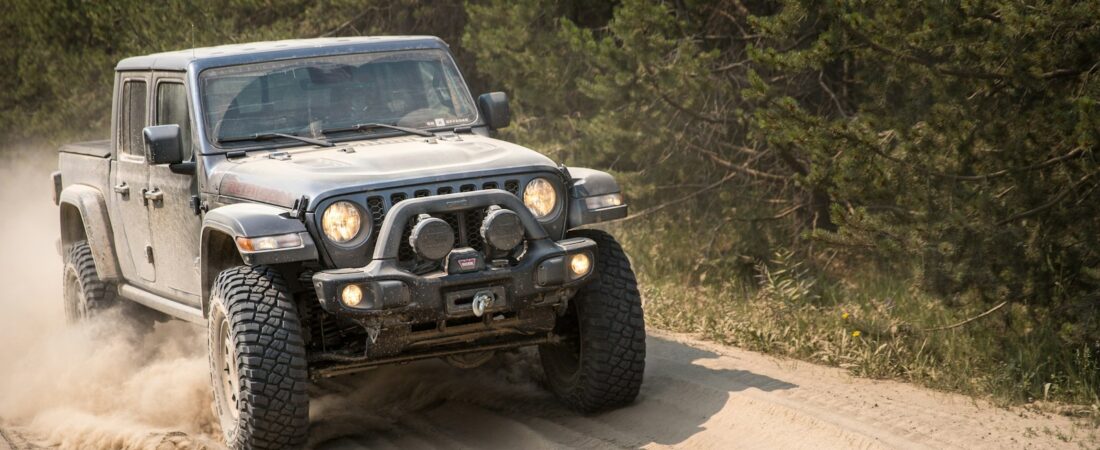
Why the JT Is One of the Most Interesting Trucks on the Road
Everyone has the same first take on the Gladiator. It’s a Wrangler with a bed. Longer wheelbase, add some truck capability, call it a day.
That take falls apart once you look at how Jeep actually engineered the platform.
The JT had to do things that no other midsize truck was asked to do at the same time. It needed to articulate like a dedicated off-road vehicle, tow like a real truck, survive crash testing without a fixed roof structure, handle oversized tires, and still be something a normal person could drive to work every day. Those requirements pull in completely opposite directions, and the engineering decisions Jeep made to satisfy all of them explain almost everything people love and hate about this truck.
The modern midsize truck market mostly moved toward refinement, efficiency, and broad consumer usability. Trucks like the Toyota Tacoma, Ford Ranger, and Chevrolet Colorado became increasingly isolated from the terrain underneath them. The Gladiator went the other direction. Jeep prioritized articulation, modularity, suspension travel, durability, and mechanical simplicity, even when that meant compromising steering precision and on-road refinement.
Platform Origins
The Gladiator went into production for 2020 at Toledo Supplier Park in Ohio. It shares a lot of architecture with the JL Wrangler Unlimited, but the differences run much deeper than most people realize.
Jeep chief engineer Pete Milosavlevski was pretty direct about it during development interviews: the Gladiator was never supposed to be a Wrangler with a bed. It was engineered from the start as a dedicated midsize pickup that happened to carry Wrangler DNA.
The most obvious change is wheelbase. The Gladiator runs about 19.4 inches longer than the four-door Wrangler Unlimited. That extra length does a lot of good things: better towing stability, improved ride quality, less pitch motion on the highway, and more composure at speed off-road.
The tradeoff is breakover angle. A longer truck drags its belly on steep terrain more easily, and that becomes a real limitation in technical rock crawling situations. Jeep made that compromise intentionally. They gave up some extreme off-road geometry to make the truck function properly as a truck.
Key Dimensions (Rubicon)
| Wheelbase | 137.3 in |
| Overall Length | 220.0 in |
| Ground Clearance | 11.1 in |
| Approach Angle | 43.4° |
| Breakover Angle | 20.3° |
| Departure Angle | 26.0° |
The longer wheelbase also changes how the truck feels dynamically. A Wrangler tends to feel short, upright, and reactive. The Gladiator feels calmer and more planted at speed, especially on rough surfaces or while towing.
The Frame Is More Modern Than You Think
Because the Gladiator uses solid axles and body-on-frame construction, a lot of people assume the platform is basically old technology with a new body on top.
That’s not what’s going on underneath.
According to FCA engineering presentations shown during the 2019 Great Designs in Steel conference, the JT/JL platform uses a surprisingly advanced mix of materials and manufacturing techniques.
The frame itself is nearly 80 percent high-strength or advanced-high-strength steel. The body structure is over 40 percent high-strength steel or stronger. Jeep also used hot-stamped ultra-high-strength steel in the upper cage structure specifically to improve rollover protection and crash performance, which matters a lot on a vehicle where the roof can be removed entirely.
Frame Material Breakdown
| Mild Steel | 15.2% |
| High-Strength Steel | 57.3% |
| Advanced High-Strength Steel | 21.5% |
| Aluminum | 3.0% |
Jeep also used tailor-rolled blanks, where different steel thicknesses are integrated into the same component so strength exists only where it’s needed. That approach alone removed roughly 19 pounds from the frame structure.
Across the JL/JT platform compared to the old JK Wrangler, Jeep shed more than 112 pounds despite tighter crash standards, more NVH countermeasures, and larger structural demands.
The aluminum usage is also more thoughtful than people expect. The hood, doors, hinges, fenders, windshield frame, and tailgate outer structure all use aluminum. That doesn’t just reduce total weight — it removes weight high in the body, lowering the centre of gravity and reducing stress on removable components like the doors and hinges.
Jeep also engineered the structure to avoid direct aluminum-to-steel joints wherever possible, keeping aluminum attached to aluminum and steel attached to steel to reduce long-term galvanic corrosion risk. That’s not the kind of detail most people associate with a truck that regularly gets covered in mud and road salt.
Suspension: Why the Solid Axle Is Still Here
The Gladiator keeps solid axles front and rear. In 2026, that makes it basically unique in the midsize truck segment.
The Tacoma went independent front suspension. The Ranger went independent front suspension. The Colorado went independent front suspension. Jeep held the line.
The front suspension uses a solid Dana axle, five-link geometry, coil springs, a track bar, and electro-hydraulic steering. The rear is also a five-link coil setup with trailing arms, a track bar, progressive-rate springs, and forward-facing shocks.
The solid axle itself is the defining engineering decision. A solid axle maintains constant differential ground clearance regardless of suspension movement. Solid axles also tolerate oversized tires extremely well because suspension geometry changes less dramatically when modified. You can run 37s or even 40s without the geometry complications that come with heavily modified independent setups.

The tradeoffs are real though: more unsprung mass, more steering kickback, less precision on pavement, and greater sensitivity to wheel offset and tire weight. You feel that solid axle every time the front tires hit a sharp edge at speed.
A Tacoma isolates the driver from terrain better. A Gladiator communicates terrain back through the chassis. Neither approach is objectively wrong. They just prioritize different experiences.
Steering
The Gladiator uses an electro-hydraulic recirculating-ball steering system with a 13.3:1 ratio. Compared to a modern rack-and-pinion setup, recirculating-ball steering handles off-road impacts well, tolerates large tires, and survives heavy loads better. The downside is less precision, more play around centre, and slower response.
This is why steering feel is one of the most common complaints on modified Gladiators, and it’s often not the truck itself causing the issue. Aggressive wheel offsets, oversized tires, heavy wheels, and poor alignment all feed directly into that steering system and amplify its weaknesses. If a Gladiator wanders on the highway, alignment and wheel setup are usually the first places to look before blaming the platform itself.
Brakes
The Gladiator’s brakes are larger than many people expect from a midsize truck.
| Front Rotors | 330 x 28 mm vented |
| Front Calipers | 51 mm twin-piston floating |
| Rear Rotors | 345 x 22 mm vented |
| Rear Calipers | 51 mm single-piston floating |
Those rear rotors are especially large, likely because of towing loads, rear axle weight transfer, and the additional rotating mass associated with larger tires.
Weight is the Gladiator’s biggest enemy, and the braking system is one of the first places where that becomes noticeable. Heavy steel bumpers, rooftop tents, bed racks, beadlocks, and 37-inch tires can dramatically increase stopping distances and brake heat. Many modified Gladiators immediately gain 500 to 1,000 pounds in aftermarket parts, fundamentally changing the way the truck behaves.
Towing
Getting from the Wrangler’s 3,500-pound towing capacity to the Gladiator’s 7,650-pound rating required much more than adding wheelbase. According to Jeep engineering interviews, the Gladiator received increased cooling airflow, larger grille openings, revised suspension tuning, strengthened frame sections, and a Class IV hitch system. The truck also meets SAE J2807 towing standards.

The longer wheelbase does most of the heavy lifting dynamically. More distance between the rear axle and hitch point means reduced trailer sway, smoother load transfer, and more predictable behaviour under load. That’s why the Gladiator feels substantially more stable towing than a Wrangler despite sharing much of the same architecture.
Powertrain: Two Philosophies
The standard Gladiator uses the 3.6-litre Pentastar V6 producing 285 horsepower and 260 lb-ft of torque, paired with an 8-speed automatic transmission. It’s a naturally aspirated engine, which means predictable throttle response, linear power delivery, and lower overall system complexity. The downside is less low-end torque compared to modern turbocharged competitors.
Jeep compensates with aggressive axle ratios, strong transfer-case gearing, and robust driveline components. Compare that to the modern Tacoma, which now uses a turbocharged 2.4-litre four-cylinder and optional i-FORCE MAX hybrid system producing up to 465 lb-ft of torque. Toyota achieves that through boost pressure, hybrid assistance, and highly optimized torque management. Jeep achieves capability more mechanically through gearing, driveline robustness, and axle strength.
The EcoDiesel option is where the Gladiator gets especially interesting for people running larger tires or towing regularly. With 418 lb-ft of torque, the diesel transforms the way the truck feels under load. It moves larger tires much more naturally and requires less aggressive gearing to maintain drivability. The tradeoff is payload — EcoDiesel payload numbers can drop into the 800-pound range depending on configuration, which becomes a real limitation for heavily loaded overland builds.
Rubicon vs Mojave: Two Different Trucks
The Rubicon and Mojave are not just trim packages with different stickers. They represent genuinely different engineering priorities.

The Rubicon is optimized for slow-speed technical terrain, articulation, and maximum traction. It receives front and rear lockers, electronic sway-bar disconnect, Rock-Trac transfer case, and aggressive crawl-focused geometry.
The Mojave was engineered for high-speed desert running, impact absorption, and stability at speed. It receives FOX internal bypass shocks, hydraulic jounce bumpers, reinforced frame sections, thicker front axle tubes, and cast iron steering knuckles. The Mojave also went through its own durability testing cycle focused specifically on repeated high-speed desert impacts.
Notably, Jeep intentionally left the front locker and sway-bar disconnect out of the Mojave. That wasn’t cost cutting — it was part of the vehicle’s intended mission. Jeep reduced unnecessary weight and complexity to focus on the type of driving Mojave owners actually do.
The Mojave proves the solid-axle platform has far more range than many people assume. Jeep took essentially the same core architecture and turned it from a rock crawler into a desert runner without abandoning the suspension philosophy entirely.